Fact Check: Misleading Protest Videos on Social Media Often Use Old or Miscaptioned Footage
Not every viral protest video tells the full story. Fact-checkers are increasingly finding recycled footage and misleading captions being used to shape public opinion online. Here's how verification works.
Viral Claims Spread Faster Than Verification
In the age of social media, videos of protests can travel across the internet within minutes, often reaching millions of viewers before their authenticity is verified. A recurring trend observed by fact-checkers worldwide involves old protest footage, unrelated demonstrations, or videos from different countries being shared with misleading captions that falsely connect them to current political events.
These posts frequently generate strong reactions because they appear to provide visual evidence of public unrest, government action, or political opposition. However, digital verification experts warn that many viral protest videos circulating online contain inaccurate descriptions, lack proper context, or are deliberately miscaptioned to support specific narratives.
As misinformation continues to influence public discourse, verifying the origins of protest-related content has become an increasingly important part of responsible journalism and digital literacy.
The Claim
Several videos currently circulating across social media platforms claim to show ongoing protests linked to recent political developments, government policies, election-related events, or public demonstrations.
Many posts describe the footage as evidence of widespread unrest, clashes with authorities, or large-scale public opposition. In numerous cases, the accompanying captions provide little information about when or where the videos were recorded.
The posts often rely on dramatic visuals rather than verifiable details, making independent verification essential.
Initial Verification Raises Questions
One of the first steps in assessing viral protest videos is determining whether the footage is actually connected to the event described in social media posts.
Digital investigators typically examine:
- Upload history
- Original source accounts
- Dates of publication
- Geographic indicators
- News coverage
- Visual landmarks
- Audio cues
- Metadata when available
In many misleading cases, investigators discover that videos were uploaded months or even years before the events they supposedly depict.
This discrepancy immediately raises concerns about the accuracy of the claims attached to the footage.
Recycled Videos Are a Common Misinformation Tactic
Fact-checking organizations frequently encounter recycled videos during major political developments, elections, protests, conflicts, and public emergencies.
A video recorded during one demonstration may later be shared as evidence of an entirely different event.
For example, footage from labor protests, student demonstrations, transportation strikes, religious gatherings, sporting celebrations, or unrelated public events may be reposted with captions claiming it represents a current political movement.
Because many users encounter the video without seeing its original publication date, the misleading context can spread rapidly.
Researchers studying misinformation note that recycled content is often more effective than fabricated content because the footage itself is genuine. The deception occurs through the false description attached to it.
Reverse Video Searches Reveal Earlier Uploads
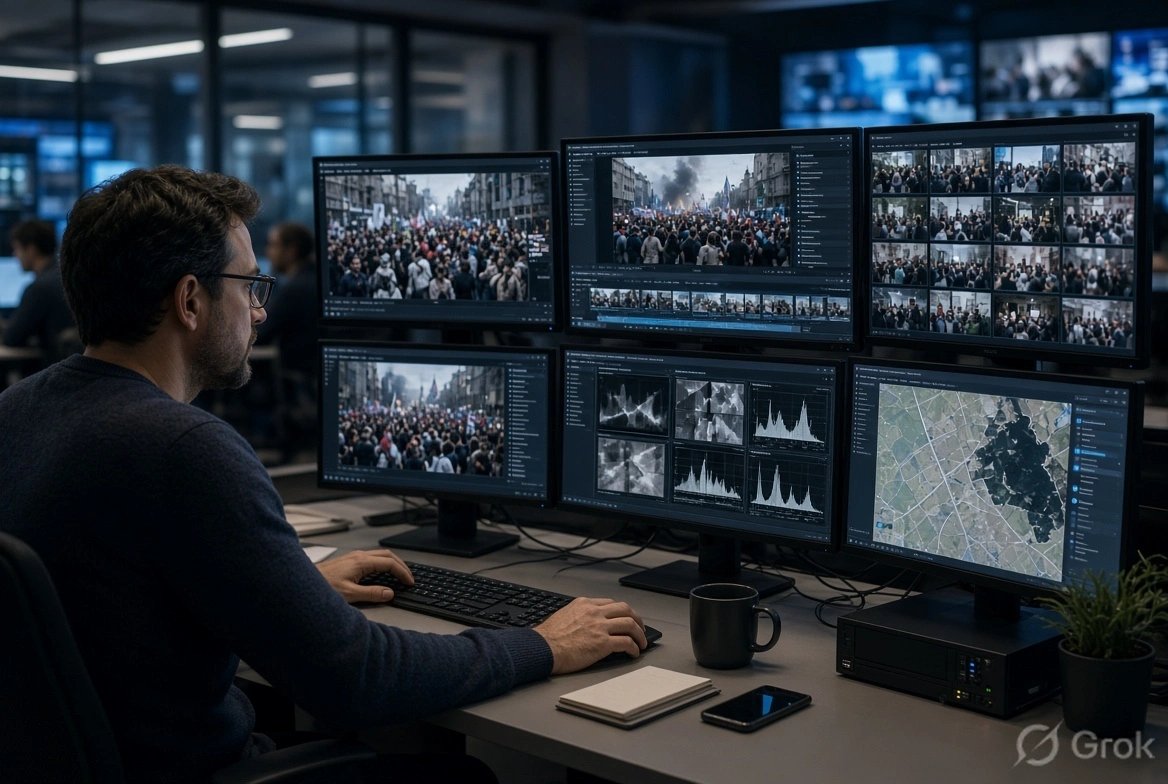
One of the most effective verification methods involves reverse image and reverse video searches.
Investigators extract key frames from viral clips and compare them against previously published content available online.
These searches frequently reveal that supposedly "breaking" protest footage appeared on the internet long before the event referenced in social media posts.
In some instances, videos presented as recent protests have been traced back to demonstrations that occurred years earlier.
When earlier uploads are identified, investigators compare timestamps, locations, and accompanying descriptions to determine the video's true origin.
This process often provides critical evidence regarding whether the viral claim is accurate.
Geolocation Helps Establish Context
Geolocation analysis is another important verification tool.
Digital investigators examine visible landmarks such as:
- Government buildings
- Street signs
- Storefronts
- Public monuments
- Road layouts
- Transportation infrastructure
- Natural features
These visual clues can often be matched with satellite imagery, mapping services, archived photographs, and publicly available location databases.
If a video claims to show protests in one city but visual evidence matches a completely different location, the claim can be challenged or disproven.
Geolocation has become particularly important because many misleading social media posts intentionally omit location details or provide inaccurate information regarding where footage was recorded.
Miscaptioned Videos Can Distort Public Understanding
Not every misleading protest video is entirely false.
In many cases, authentic footage is paired with inaccurate explanations.
For example, a peaceful demonstration may be presented as a violent confrontation. A local protest may be described as a nationwide movement. A gathering connected to one issue may be falsely linked to another political event.
These misrepresentations can significantly alter public perceptions.
Experts emphasize that context is often as important as authenticity. A genuine video can still be misleading if viewers are given false information about its date, location, participants, or purpose.
This distinction is particularly important during politically sensitive periods when public opinion may be influenced by incomplete or inaccurate information.
Why Protest Footage Is Frequently Targeted
Protest videos possess characteristics that make them highly attractive for misinformation campaigns.
Large crowds, emotional reactions, police presence, banners, and public demonstrations create compelling visual content that captures attention quickly.
Such footage can be used to support a wide range of narratives, including claims about government popularity, public dissatisfaction, political instability, or social unrest.
Because viewers often interpret video as direct evidence, misleading protest footage can appear especially persuasive.
Researchers studying online misinformation have repeatedly found that emotionally charged visual content tends to generate higher engagement than text-based claims.
This dynamic increases the likelihood that misleading videos will be shared widely before verification occurs.
The Role of AI and Editing Tools
While recycled footage remains one of the most common misinformation techniques, emerging technologies are creating additional challenges.
Modern editing software can alter videos by changing audio, adding misleading captions, cropping contextual details, or combining footage from multiple sources.
Artificial intelligence tools are also making it easier to manipulate visual content, although many misleading protest videos still rely primarily on old footage rather than fully synthetic media.
Verification experts therefore recommend examining not only whether a video is authentic but also whether it has been edited, selectively presented, or stripped of critical context.
Understanding how footage has been modified is often essential for accurate reporting.
What Viewers Should Check Before Sharing
Fact-checkers encourage social media users to verify protest-related content before reposting it.
Key questions include:
- Who originally recorded the video?
- When was it first published?
- Is the location confirmed?
- Have reputable news organizations reported the event?
- Does reverse searching reveal earlier uploads?
- Are official sources providing additional information?
- Does the caption accurately describe what is visible?
If clear answers are unavailable, caution is warranted.
Sharing unverified content can unintentionally contribute to misinformation even when users believe they are helping inform others.
Verdict
Analysis of many viral protest videos circulating online shows that some are recycled from older events, while others are shared with misleading or incomplete captions that distort their original context.
Although the footage itself may be genuine, claims regarding the date, location, purpose, or participants are not always supported by available evidence.
Verification through reverse searches, geolocation analysis, source identification, and independent reporting remains essential before drawing conclusions about viral protest videos.
As social media continues to serve as a primary source of news for millions of people, distinguishing between authentic reporting and misleading context has become increasingly important. In many cases, the most significant question is not whether a video is real—but whether the story attached to it is accurate.
What's Your Reaction?
 Like
0
Like
0
 Dislike
0
Dislike
0
 Love
0
Love
0
 Funny
0
Funny
0
 Wow
0
Wow
0
 Sad
0
Sad
0
 Angry
0
Angry
0

The Excuse Alliance is an independent digital news platform covering India’s latest developments in politics, business, technology, society, economy, and public affairs. Our mission is to provide accurate, fact-based, and trustworthy journalism that keeps readers informed about the issues shaping India.







Comments (0)