

How False Information Spreads on WhatsApp in India: Inside the Networks Driving Viral Misinformation
Explore how misinformation spreads on WhatsApp in India, the networks behind viral false claims, the challenges faced by fact-checkers, and why digital literacy is crucial in combating online misinformation.
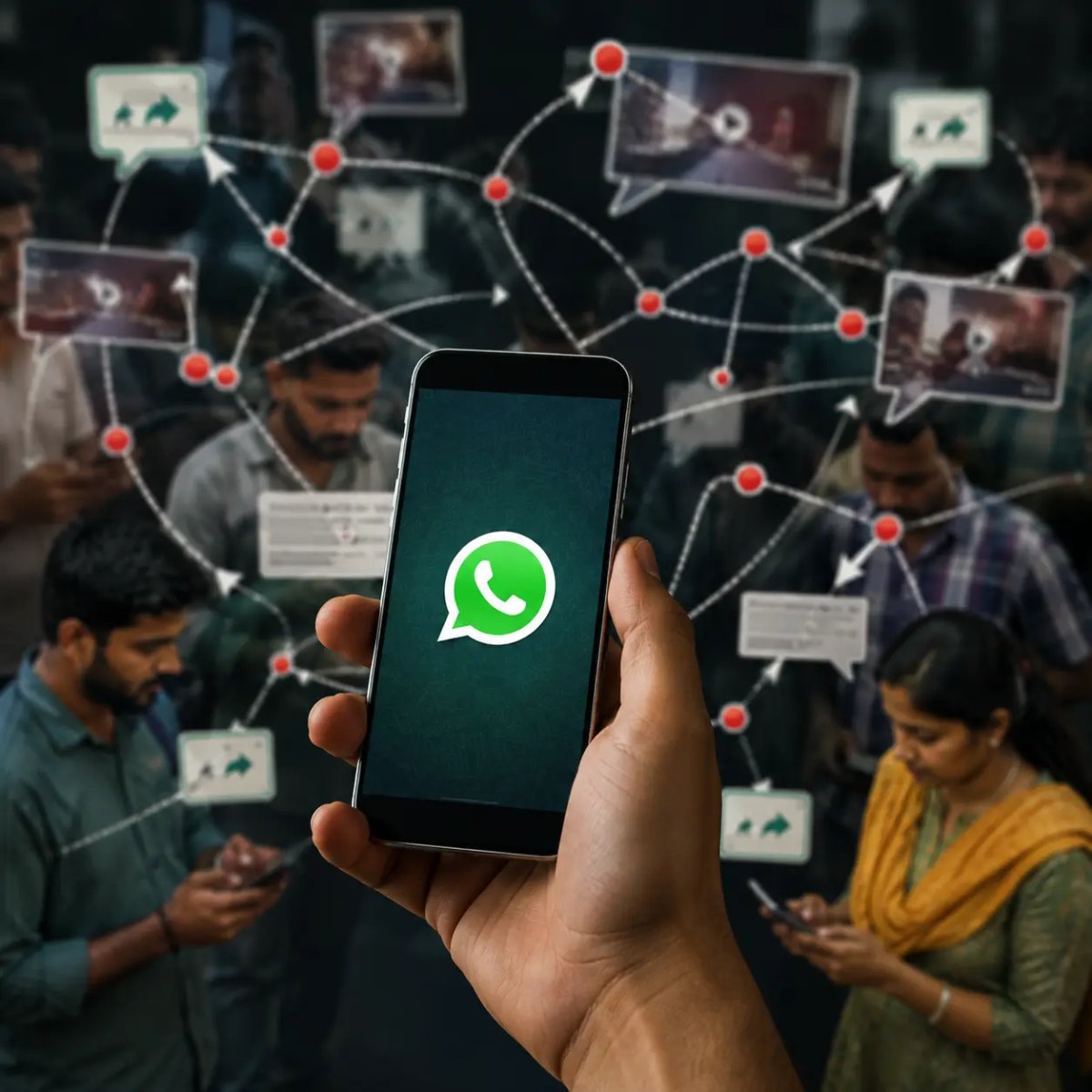
In a country with more than a billion mobile connections and one of the world's largest internet user bases, information now travels faster than ever before. A message created in one corner of India can reach thousands of people within minutes and potentially millions within hours. While this connectivity has transformed communication, it has also created a powerful channel for the spread of false information.
WhatsApp, one of India's most widely used messaging platforms, has become central to discussions about misinformation. From fabricated health advice and manipulated videos to misleading political claims and communal rumors, false information shared through private messaging networks continues to pose challenges for citizens, policymakers, technology companies, and fact-checkers.
Experts say understanding how misinformation spreads is essential to reducing its impact, particularly in a country where digital communication increasingly shapes public opinion and decision-making.
Why WhatsApp Plays a Unique Role in Information Sharing
Unlike public social media platforms where content can be viewed and monitored openly, WhatsApp operates primarily through private conversations and encrypted messaging. This privacy is one of the platform's most valued features, but it also makes tracking the spread of false information more difficult.
India remains one of WhatsApp's largest markets globally, with hundreds of millions of users relying on the platform for daily communication. Family groups, neighborhood communities, workplace chats, school parent groups, religious networks, and local organizations often use WhatsApp as a primary source of information.
Researchers studying misinformation have noted that users frequently trust messages received from friends, relatives, or community members more than information encountered on public platforms. This trust can increase the likelihood that content will be forwarded without verification.
A misleading message shared by a family member may appear more credible simply because of the relationship between sender and recipient.
The Data Behind Misinformation Networks
Studies conducted by digital rights organizations, academic institutions, and fact-checking groups have repeatedly shown that misinformation spreads through networks rather than isolated individuals.
Most viral false claims do not originate from ordinary users. Instead, misinformation often begins with a small number of sources before moving through interconnected groups and communities.
Researchers describe this process as a "cascade effect."
A typical misinformation chain may follow this pattern:
- A misleading image, video, or text message is created.
- The content is shared in a limited number of groups.
- Early recipients forward it to trusted contacts.
- The message reaches multiple community networks.
- Repeated exposure creates an impression of legitimacy.
- Users begin treating the claim as verified information.
The challenge is that by the time fact-checkers identify and debunk a false claim, it may already have reached thousands of users.
Digital misinformation researchers have found that emotionally charged content often travels faster than factual corrections. Messages that trigger fear, anger, outrage, or excitement tend to receive higher engagement and forwarding rates.
Why People Share False Information
Experts caution against assuming that most people intentionally spread misinformation.
In many cases, users share content because they believe it may be useful or important.
Several factors contribute to the spread of false information:
Trust in Personal Networks
People often place significant trust in information received from family members, friends, colleagues, and community leaders.
This trust can reduce skepticism and discourage fact-checking.
Confirmation Bias
Users are more likely to believe and share information that aligns with their existing views, beliefs, or assumptions.
If a message appears to confirm what someone already thinks, they may be less likely to question its accuracy.
Information Overload
India's digital ecosystem generates enormous amounts of content every day.
Many users do not have the time or resources to verify every message they receive.
Fear of Missing Important Information
Health alerts, safety warnings, government announcements, and financial advice frequently circulate on WhatsApp.
Users sometimes forward messages quickly because they believe the information could help others, even when verification is lacking.
The Role of Images, Videos, and Edited Content
Modern misinformation is increasingly visual.
Fact-checking organizations report that manipulated videos, edited images, and misleading captions often generate stronger reactions than text-only messages.
A genuine photograph may be reused with a false description.
A video from another country may be presented as an event occurring in India.
Artificial intelligence tools and editing software have further complicated verification efforts by making it easier to alter content.
As a result, digital literacy experts recommend evaluating both the content itself and its source before accepting claims as factual.
Election Periods and Public-Interest Risks
Misinformation tends to increase during major public events, including elections, natural disasters, health emergencies, and periods of social tension.
During election seasons, false claims about political parties, candidates, voting procedures, and public policies can circulate rapidly across messaging networks.
Researchers have observed that misinformation during elections may contribute to voter confusion and distort public debate.
Similarly, false medical advice has become a concern during health crises. Public health experts warn that inaccurate information can influence behavior, delay treatment decisions, and undermine trust in credible sources.
The consequences of misinformation extend beyond digital spaces and can affect real-world decisions.
What WhatsApp and Technology Platforms Have Changed
In response to concerns about misinformation, WhatsApp has introduced several measures over recent years.
These include:
- Forwarding limits on messages.
- Labels indicating when content has been forwarded multiple times.
- Educational campaigns promoting digital literacy.
- Partnerships with fact-checking organizations in various regions.
The platform has stated that limiting message forwarding has helped reduce the virality of highly forwarded content.
However, experts emphasize that technological solutions alone cannot eliminate misinformation.
The problem often involves human behavior, information literacy, and broader social dynamics.
The Growing Importance of Fact-Checking
India has seen significant growth in independent fact-checking initiatives over the past decade.
Fact-checkers regularly investigate viral claims involving politics, public policy, health, finance, and social issues.
These organizations use tools such as reverse image searches, metadata analysis, geolocation techniques, and official records to verify claims.
Despite these efforts, fact-checkers face a fundamental challenge: corrections rarely spread as quickly as the original misinformation.
This phenomenon, sometimes called the "truth lag," means false claims often gain substantial visibility before accurate information catches up.
Experts suggest that prevention may be more effective than correction alone.
Building Digital Resilience
Researchers increasingly argue that combating misinformation requires a combination of technology, education, and public awareness.
Digital literacy programs encourage users to ask basic verification questions before forwarding content:
- Who created this message?
- Is the source identifiable?
- Has the claim been reported by credible news organizations?
- Can supporting evidence be verified?
- Is the content designed to provoke an emotional reaction?
These simple checks can significantly reduce the likelihood of sharing inaccurate information.
Educational institutions, civil society groups, technology companies, and media organizations all have a role to play in strengthening information literacy.
Looking Ahead
As India's digital ecosystem continues to expand, the challenge of misinformation is likely to evolve alongside new technologies and communication habits.
WhatsApp remains an essential tool for communication, business, education, and community engagement. At the same time, its vast reach highlights the importance of responsible information sharing.
The broader issue is not merely the existence of false information but the speed and scale at which it can travel through trusted networks. Understanding those networks—and the human behaviors that drive them—may be one of the most important steps toward building a more informed digital society.
For citizens navigating an increasingly connected world, the ability to verify information before sharing it is becoming as important as access to information itself. In the fight against misinformation, every forward carries responsibility.
What's Your Reaction?
 Like
0
Like
0
 Dislike
0
Dislike
0
 Love
0
Love
0
 Funny
0
Funny
0
 Wow
0
Wow
0
 Sad
0
Sad
0
 Angry
0
Angry
0

The Excuse Alliance is an independent digital news platform covering India’s latest developments in politics, business, technology, society, economy, and public affairs. Our mission is to provide accurate, fact-based, and trustworthy journalism that keeps readers informed about the issues shaping India.








Comments (0)