

India’s Monsoon Season 2026: Are States Better Prepared for Floods Than Before?
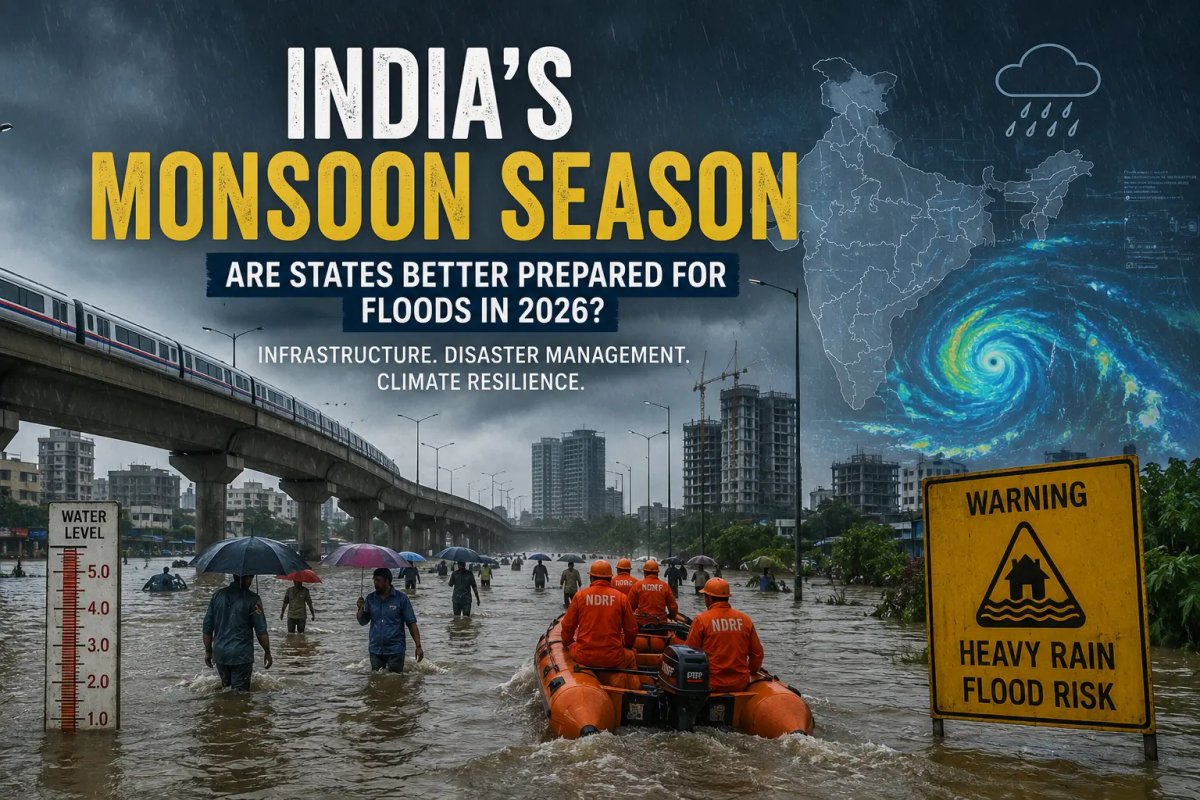
Every year, India’s monsoon season brings both relief and risk. The rains are essential for agriculture, reservoirs, and drinking water supplies, but they also trigger floods, landslides, infrastructure failures, and large-scale displacement.
The 2026 monsoon has once again tested the country’s preparedness. Heavy rainfall warnings have been issued across multiple states, while flood-related emergencies have been reported from Assam, Himachal Pradesh, Maharashtra, and several other regions. The question policymakers, urban planners, and citizens are asking is simple: Are Indian states better prepared for floods in 2026 than they were a decade ago?
A Monsoon Under Pressure
India's monsoon remains one of the world's most complex weather systems. The India Meteorological Department (IMD) has forecast active monsoon conditions across large parts of the country, with several regions facing risks of heavy rainfall, flash floods, and landslides.
Recent weeks have demonstrated how quickly weather events can turn deadly.
In Assam, severe flooding has affected hundreds of thousands of residents, damaged homes, and disrupted transportation networks. Rivers, including the Brahmaputra, crossed danger levels after prolonged rainfall, forcing large-scale evacuations.
In Himachal Pradesh, relentless rains have led to road closures, infrastructure damage, and dozens of fatalities, highlighting the vulnerability of mountain states to extreme weather events.
Meanwhile, Mumbai witnessed another reminder of urban flood risks when intense rainfall triggered a deadly landslide in a densely populated area.
What Has Improved Since Past Monsoons?
Despite the challenges, disaster management experts say India is considerably better prepared today than it was ten or fifteen years ago.
One of the biggest improvements has been the expansion of early warning systems. Weather forecasts are more accurate, alerts reach citizens faster through smartphones and messaging platforms, and state governments have invested in emergency response mechanisms.
The National Disaster Management Authority (NDMA), state disaster management agencies, and the National Disaster Response Force (NDRF) have strengthened coordination during flood emergencies. Rescue teams are often deployed before rivers reach critical levels, reducing response times.
Meteorologists point out that forecasting capabilities have significantly advanced due to better satellite data, radar networks, and numerical weather prediction models.
"The accuracy of short-term rainfall forecasts has improved substantially over the last decade," says a senior meteorologist familiar with India's forecasting systems. "States now receive more detailed alerts that help them prepare evacuations and emergency operations earlier than before."
Infrastructure Remains a Weak Link
While forecasting has improved, infrastructure continues to be a major concern.
Across many cities, heavy rainfall still leads to waterlogging, traffic paralysis, and disruptions to essential services.
Pune's 2026 monsoon season exposed several weaknesses in urban infrastructure despite pre-monsoon preparations. Experts noted recurring waterlogging, transportation disruptions, and concerns over long-term planning.
Urban planners argue that the problem is often not the amount of rain but the way cities are designed.
Rapid urbanization has replaced natural drainage channels with roads, concrete surfaces, and construction projects. Water that once flowed into wetlands and open land now accumulates on streets and in residential neighborhoods.
"Many Indian cities are still using drainage systems designed for rainfall patterns of previous decades," says an urban planning consultant specializing in climate resilience. "But climate change is increasing rainfall intensity, and infrastructure has not always kept pace."
Mumbai, Bengaluru, Chennai, Hyderabad, and several rapidly growing Tier-2 cities continue to face recurring flood challenges during periods of intense rainfall.
Climate Change Is Changing the Equation
The challenge facing states in 2026 is very different from the one they faced twenty years ago.
Climate scientists increasingly warn that climate change is making rainfall patterns more unpredictable. Research indicates growing rainfall variability and an increase in extreme precipitation events in parts of India.
Experts note that rainfall is becoming more concentrated, with shorter periods delivering larger volumes of water.
This creates a difficult situation for disaster managers.
A city may receive an entire month's worth of rainfall within a few days, overwhelming drainage systems, roads, bridges, and emergency services.
Floods that were once considered rare are becoming more frequent, while regions previously seen as low-risk are experiencing unexpected flooding events.
Are States Investing in Climate Resilience?
Several states have increased investments in flood mitigation and climate adaptation projects.
These initiatives include:
- Strengthening embankments and flood barriers.
- Upgrading drainage systems.
- Expanding flood forecasting networks.
- Improving emergency operation centers.
- Using satellite-based monitoring technologies.
- Conducting pre-monsoon preparedness exercises.
India has also played a growing role internationally through initiatives focused on disaster resilience and climate adaptation. Programs promoting resilient infrastructure aim to help communities withstand extreme weather events more effectively.
However, implementation remains uneven across states.
Some regions have developed robust preparedness systems, while others continue to struggle with funding limitations, aging infrastructure, and rapid population growth.
Technology Is Becoming a Critical Tool
Technology is emerging as one of the strongest defenses against flood disasters.
Machine learning, satellite imagery, river monitoring systems, and predictive analytics are increasingly being used to improve flood forecasting.
Researchers have demonstrated that advanced flood prediction models can provide earlier warnings and more accurate flood mapping, helping authorities identify high-risk areas before disasters occur.
Several state governments are also integrating artificial intelligence and geospatial technologies into disaster management strategies.
The goal is not only to respond faster but to prevent disasters from becoming humanitarian crises.
The Human Cost of Flooding
Despite technological progress, floods continue to impose enormous human and economic costs.
Families lose homes, farmers lose crops, businesses suffer disruptions, and public infrastructure requires costly repairs.
In Assam, floodwaters displaced hundreds of thousands of residents during the current monsoon season. In Himachal Pradesh, landslides and road closures disrupted daily life across multiple districts.
These events serve as reminders that preparedness is not measured solely by the number of rescue teams deployed but by how effectively communities can withstand and recover from disasters.
The Verdict: Better Prepared, But Not Yet Prepared Enough
The evidence suggests that India is better prepared for floods in 2026 than it was in previous decades.
Forecasting systems are stronger. Emergency response mechanisms are faster. Disaster management agencies are more coordinated. Technology is playing a larger role in risk assessment and early warning.
Yet major vulnerabilities remain.
Urban infrastructure continues to lag behind climate realities. Population growth is increasing exposure to flood-prone areas. Extreme weather events are becoming more frequent and unpredictable.
For many experts, the future of flood preparedness lies not only in responding to disasters but in building cities, roads, drainage systems, and communities that are resilient enough to withstand them.
As the 2026 monsoon continues, India’s progress is visible. But so is the scale of the challenge ahead.
The next generation of flood preparedness may depend less on emergency response and more on long-term climate resilience, smarter urban planning, and infrastructure designed for a rapidly changing world.
What's Your Reaction?
 Like
0
Like
0
 Dislike
0
Dislike
0
 Love
0
Love
0
 Funny
0
Funny
0
 Wow
0
Wow
0
 Sad
0
Sad
0
 Angry
0
Angry
0

The Excuse Alliance is an independent digital news platform covering India’s latest developments in politics, business, technology, society, economy, and public affairs. Our mission is to provide accurate, fact-based, and trustworthy journalism that keeps readers informed about the issues shaping India.






Comments (0)